Sustainability - Human Rights
Since it was founded, the Meiden Group has created and supplied a variety of technologies, products, and services, with a focus on electrical equipment that supports social infrastructure, and contributed to the sustainable development of society.
Respect for human rights is the foundation of our business activities to realize our corporate philosophies of “illuminating a more affluent tomorrow” and “for customer peace of mind and satisfaction.” Through its business activities, the Meiden Group will create a joyful and sustainable society for everyone, and comply with international human rights norms as indicated by the Meiden Group Corporate Code of Conduct.
In 2022, Meidensha signed a statement of support for the United Nations Global Compact and was registered as a participating company.
We also support the National Action Plan on Business and Human Rights (2020-2025) formulated by the Japanese government in 2020, and through its implementation, we strive to promote responsible corporate behavior with regard to respect for human rights.
Specifically, we identify, prevent, and mitigate potential human rights risks and impacts in our activities, including those in our supply chain, and disclose how we address them on an ongoing basis.
As a policy for the concrete implementation of the above ideas, we have made the Meiden Group Human Rights Policy available in three languages (Japanese, English, and Chinese). In addition, we are working to ensure that it becomes ingrained in all employees through our human rights training.
Further, for the sake of both internal and external stakeholders, we regularly revise the Group’s Sustainable Procurement Guidelines, which include human rights considerations, to reduce human rights risks in our supply chain, and these guidelines are distributed to our business partners.
Twice a year, human rights progress reports are presented to the Board of Directors as part of Meidensha’s framework for promoting sustainability management. Due diligence for human rights is conducted by the Human Rights Promotion Department, which comprises primarily of the Sustainability Management Promotion Division, Human Resources Management Group, Corporate Governance Management Group, and the Procurement Group. Reports on specified and evaluated risks arising from human rights due diligence are provided to the Sustainability Management Promotion Committee and the Sustainability Management Strategy Committee, as well as to the Executive Officers’ Meetings and the Board of Directors via the Risk Management Committee. Incidents of harassment are reported and supervised at regular meetings of the Compliance Committee, and the nature of such incidents is also reported to management.
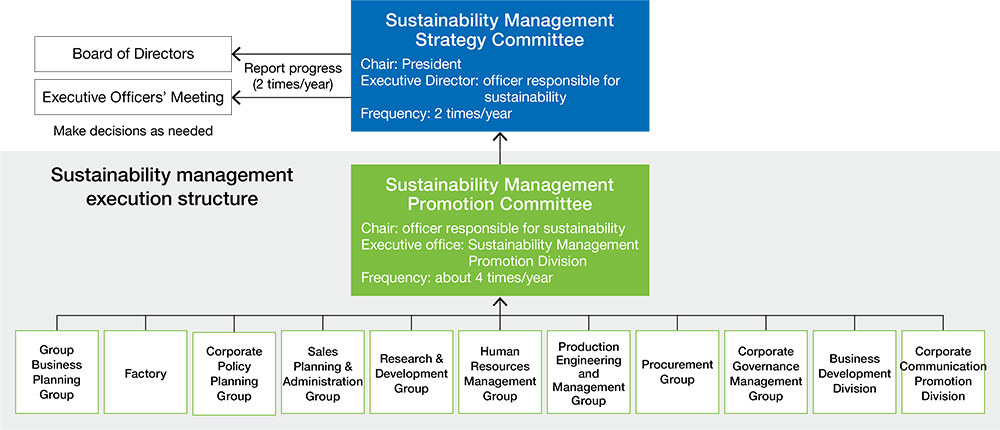
The Meiden Group practices human rights due diligence based upon international regulations such as the UN’s Guiding Principles on Business and Human Rights in order to identify, manage, prevent, and mitigate human rights risks in our business activities for all stakeholders. To date, we have developed a 4-step initiative on human rights due diligence, specifically in the order of Step 1: Process Construction, Step 2: Self-Assessment, Step 3: Risk Assessment, and Step 4: Impact Assessment.
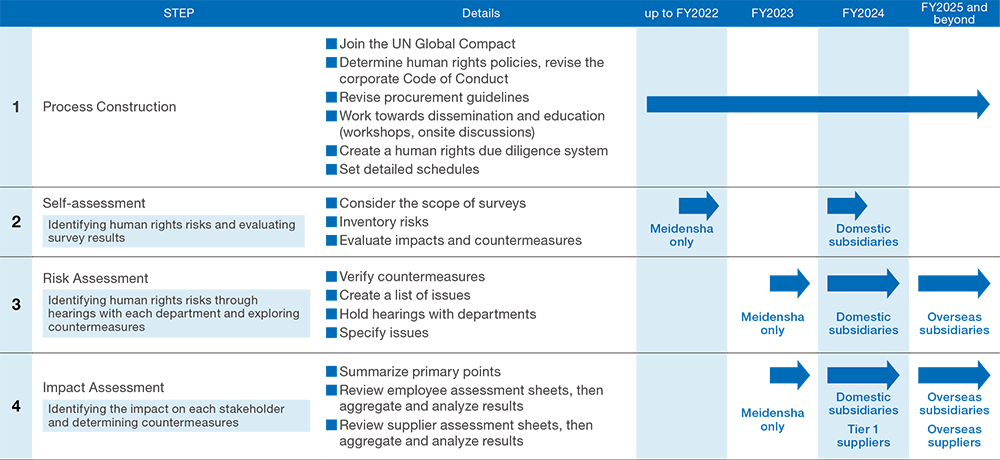
In FY2023, we conducted human rights risk impact assessments of all company employees in order to survey human rights risks (4,825 people surveyed with 3,291 respondents, a 68.2% response rate).
In FY2024 we expanded the survey range and conducted impact assessments for all employees of our domestic subsidiaries (4,460 people surveyed at 17 domestic subsidiaries, with 3,220 respondents, a 72.2% response rate).
In FY2024, we also conducted impact assessments on human rights and occupational safety and health for our primary suppliers. (377 companies surveyed, with 265 companies responding, for a 70.3% response rate.)
Based on the results of these risk assessments and impact assessments, we extracted issues reagrding human rights, evaluated and mapped the level of impact, and then identified seven areas from the table below as high risk categories that signified prominent human rights issues.
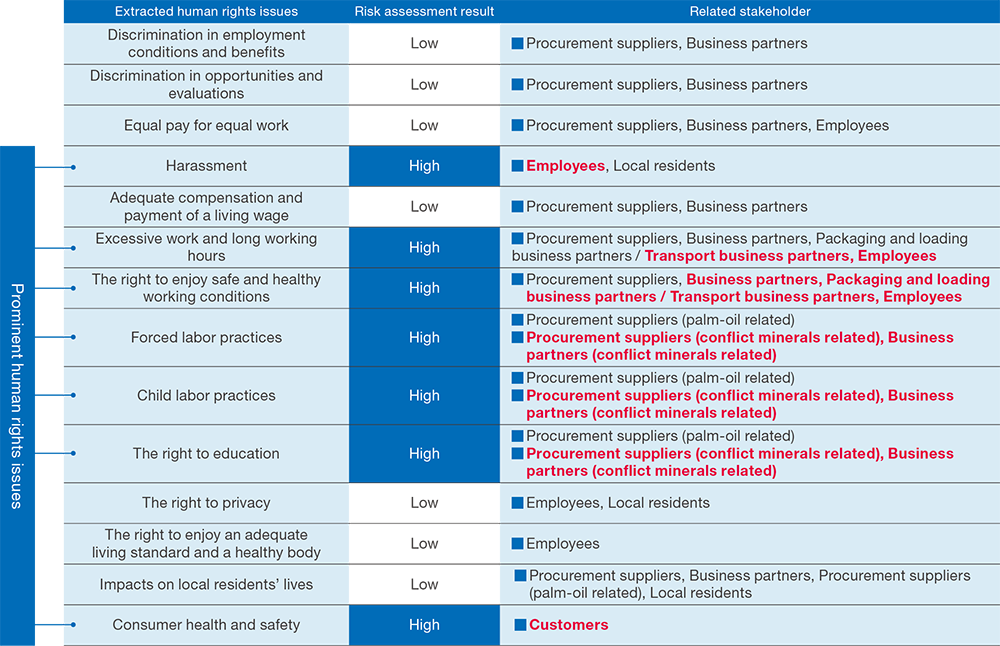
Moving forward, we will recognize these prominent human rights issues as critical and urgent issues to address and conduct more detailed surveys, then strengthen our repsones to prevent or reduce the negative impact of impediments upon human rights. We will also continue to conduct periodic impact assessments of our stakeholders and review human rights risks. By doing so, we will continually revise and prevent human rights issues and ensure the human rights of all stakeholders.
The Meiden Group has established separate consultation hotlines available to internal and external stakeholders, and accepts reports concerning a wide range of human rights issues, from those that may arise on a daily basis to serious human rights violations. The internal Compliance Hotline and the Harassment Consultation Hotline are available for reports within the Group. We have established the Compliance Whistleblowing Hotline (for compliance issues) and the Workplace Harassment Hotline (for harassment issues) as external whistleblowing services, and all stakeholders (including individuals and local residents) can use these systems to share their concerns through a contact form on our company website.
In accordance with national guidelines, the above whistleblowing services are designed to ensure information management and whistleblower protection, including the name of the whistleblower, and to allow for anonymous reporting. We take care to ensure that whistleblowers are not disadvantaged and strive to improve the credibility of our whistleblowing systems. Information received through our internal and external whistleblowing services is investigated by the Compliance Committee, Harassment Prevention Committee, and other bodies after confirming its content, and is handled in consultation with outside organizations as necessary. Additionally, in the event of a confirmed impact on human rights, we are committed to taking corrective actions and providing redress to the affected parties in accordance with the Group’s Code of Conduct and other relevant standards.
To ensure respect for human rights as stated in the Corporate Code of Conduct, the Meiden Group understands international norms (such as the Universal Declaration of Human Rights and International Bill of Human Rights) and actively engages in human rights due diligence and human rights awareness activities based on the United Nations Guiding Principles on Business and Human Rights. We also comply with all relevant laws concerning the prohibition of forced labor and abolition of child labor.
We present working conditions to employees when they are hired and we take action to prevent forced and involuntary labor.
The Meiden Group only hires senior high school graduates and up.
We value conversations between employee representatives and management to ensure that employees can engage in meaningful work. We have established a regular central labor-management conference and regional labor-management conferences, and we are working to improve the workplace environment according to the circumstances of each site.
The Meiden Group not only complies with minimum wage requirements in each prefecture in accordance with the Minimum Wages Act, but also is careful to pay at least a living wage.
We also provide a family allowance to support the lifestyles of employees who meet certain conditions such as having spouses and children to provide for. The Meiden Group Mutual Aid Association also provides various types of condolence, sympathy, and celebratory funds, as well as loans for financial assistance required for the mutual support and welfare of members. In addition, we have a home loan program to receive funding from financial institutions when those who have saved property accumulation residence funds eventually make a purchase.
In order to properly manage working hours and curb long working hours, our labor management system centrally monitors and manages PC log-ons and log-offs and employee ID card data stamps when employees arrive at and leave the office. If an employee works more than a certain number of hours, that employee and their supervisor are asked about the employee’s working conditions, and guidance is given to prevent long working hours and legal violations. Additionally, we hold briefings regularly on working hours and distribute manuals internally on working hours and attendance management to improve employee literacy on labor management. Furthermore, to encourage employees to take their annual paid leave, we established “My Plan Annual Leave” and “Recommended Days for Taking Annual Leave” to promote employee work–life balance.
Regarding harassment, we have established both an internal and external consultation system to respond promptly while adhering to the principles of protecting the privacy and confidentiality of the user. The system is available to Meiden Group employees as well as dispatch workers and contractors. Information obtained through the system is used to conduct surveys of the user and relevant parties, provide feedback after having understood the situation, and prevent recurrence. The system provides an opportunity to implement recurrence prevention measures and conduct individual education.
We have also included items concerning harassment in our employee awareness survey, which allows us to observe trends each year.
Meiden Group conducts various training programs to promote respect for basic human rights. We offer periodic group training and videos (in Japanese, English, and Chinese) on compliance and harassment to raise all Group employees’ awareness of these issues. We also increase understanding and awareness by providing opportunities for individuals to reconsider their workplace and ways of thinking. We have also expanded anger management training for managers to include all employees. Through the training, we raise awareness to respect the personalities and ideas of others.