Social

Occupation Health

Sustainability - Occupation Health

Health & Productivity Management

Policy

The Meiden Group Health & Productivity Management Policy Statement

In order to realize the Meiden Group’s corporate philosophy of “Illuminating a more affluent tomorrow,” it is essential for employees to maintain their physical and mental health, and work with vigor and purpose.

We strategically promote initiatives that unify the company and employees together and promote mental and physical wellness under a shared belief that “nothing is more valuable than good health.”

We place health and productivity management as the foundation of human capital management and aim to help in the wellbeing of our employees and their families while achieving continued corporate growth.

We advocate the following three pillars of health and productivity management.

  1. (1)Healthy Bodies
    We strive to improve fitness by improving lifestyle habits and reducing health risks.
  2. (2)Healthy Minds
    We promote the prevention and cessation of recurrence of mental health impediments.
  3. (3)Healthy Workplaces
    We create healthy work environments where individuals can utilize their talents safely and with peace of mind.

With the above three pillars of health & productivity management, we pledge to work towards becoming a company that provides a healthy and vibrant social life.

Representative Director
President and Executive Officer
Representative Director President and Executive Officer

Meiden Group’s Three Pillars of Health and Productivity Management

Meiden Group’s Three Pillars of Health and Productivity Management

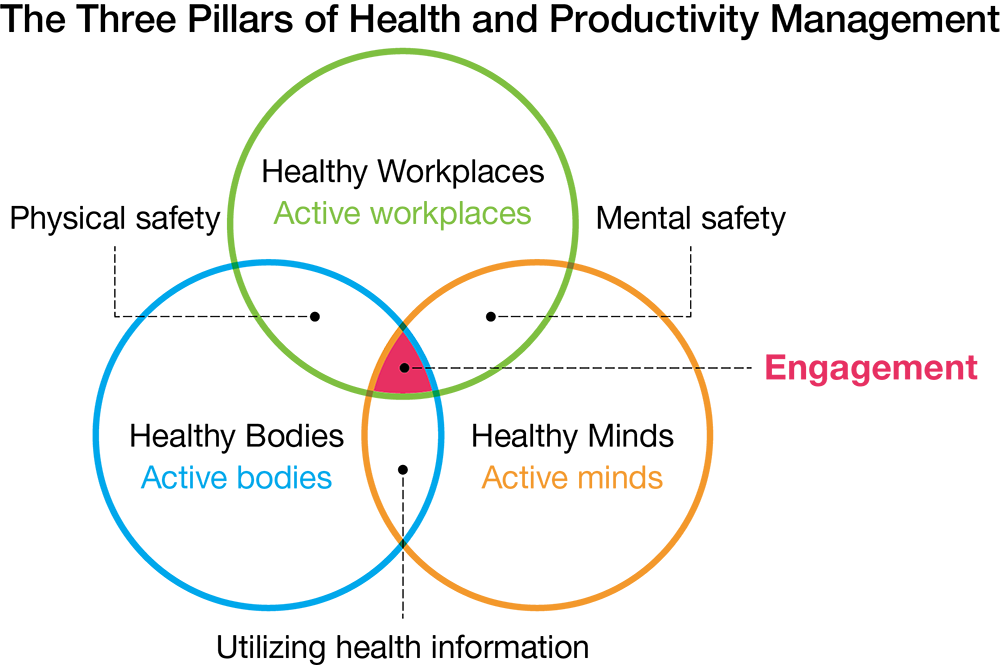
The three pillars of health and productivity management emulate the definition of health (well-being) listed in the preamble of the WHO Constitution*1. It states that “health is a state of complete physical, mental and social well-being…” and so we defined the pillars to practice in health and productivity management as “healthy bodies,” “healthy minds,” and “healthy workplaces.”

Engagement, which connects to human capital, sits at the center of the pillars, with overlapping areas of each pillar listing a shared component.
  • Healthy workplaces and healthy bodies both require physical safety (disaster prevention, establishing working environments)
  • Healthy workplaces and healthy minds both require mental safety (preventing abuses of power and mental anguish)
  • Healthy bodies and healthy minds both require utilizing health information (improving health literacy*2)
  1. *1Taken from: World Health Organization
  1. *2Health literacy: The ability to gain access to, understand, and use information in ways which promote and maintain good health

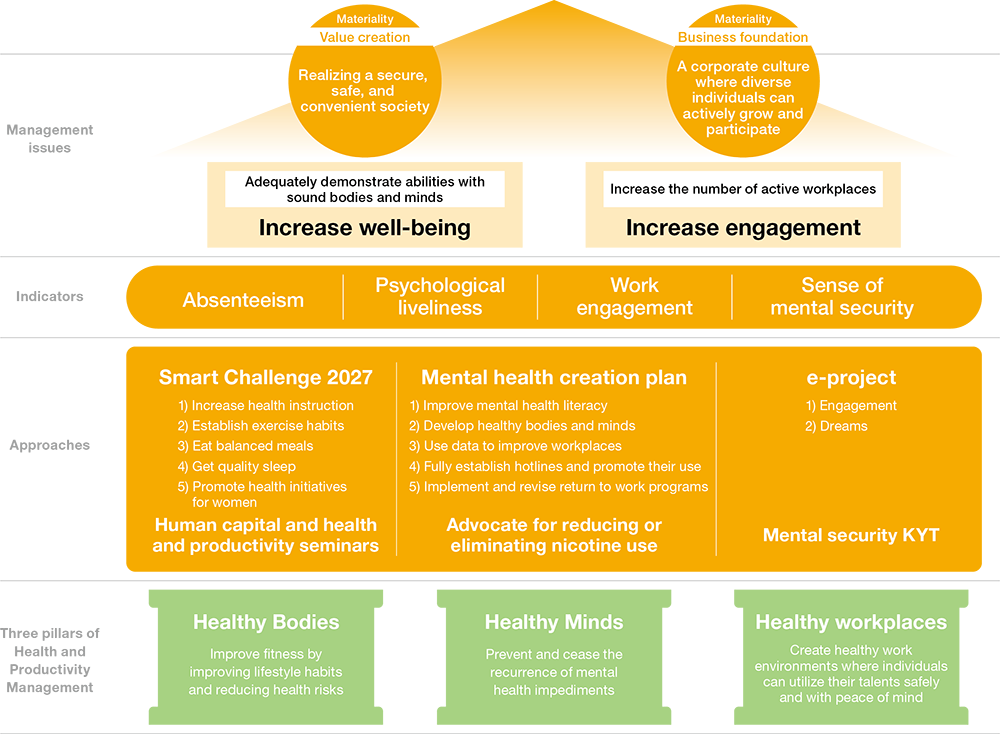
Meiden Group Health & Productivity Management Strategy Map

Meiden Group Health & Productivity Management Strategy Map
  1. *1Indicator of a sense of community, agreement with Meidensha’s philosophy and vision, and willingness to contribute, etc. (employee engagement [eNPS])
  2. *2Proportion of employees on sick leave or long-term absence for one month or more due to illness, including mental health reasons
  3. *3The degree of performance evaluated in “employee evaluations of their own work in the previous four weeks, with performance when not sick or injured acting as a baseline of 100%” in absolute presenteeism (single-item presenteeism question method)
  4. *4Indicator showing a positive mental attitude towards work
  5. *5Evaluation of support from superiors and coworkers (whether they listen and are dependable), whether challenges can be undertaken, and individual respect
  6. *6See below for information on e-project

Organization

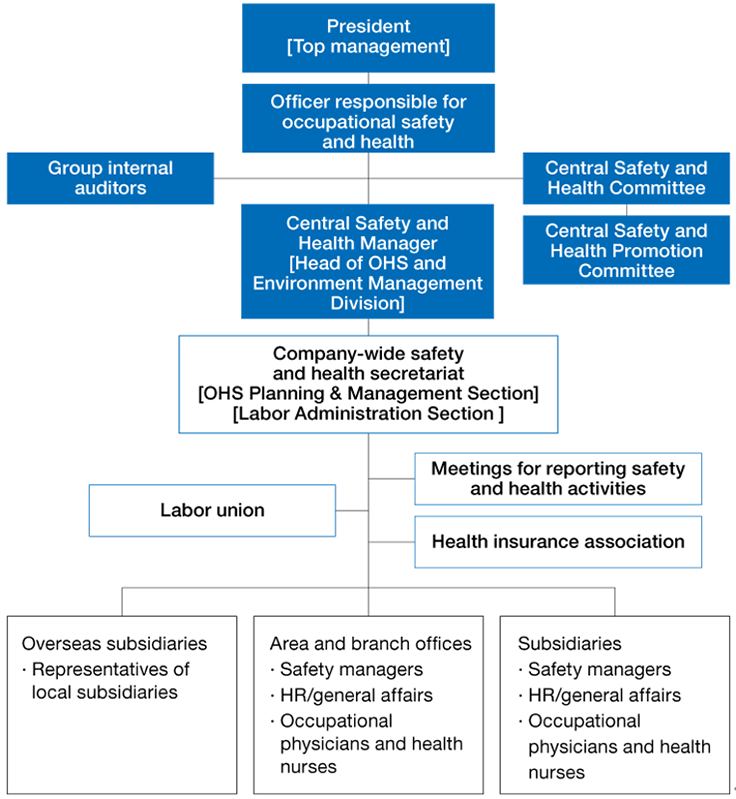
The Meiden Group Organization System for Occupational Safety and Health and health & productivity management

The Meiden Group Organization System for Occupational Safety and Health and health & productivity management

Supervision of Safety and Health Led by Top Management

In Japan, we comply with laws and regulations, hold and encourage unions and employees to participate in monthly meetings of the Safety and Health Committee at each site, and conduct consultation and information sharing relating to matters such as causes of and responses to industrial accidents, the status of employees that have taken sick leave, and other matters that require attention. Also, the Central Safety and Health Committee, chaired by the officer responsible for occupational safety and health as appointed by the President who is the head executive, discusses and makes decisions on matters relating to Group-wide policies and targets.

Results, Plan, and Targets

Results of Occupational Safety and Health Initiatives (FY2024)

(1) Received 2024 Health and Productivity
Management Outstanding Organization (White 500) Certification

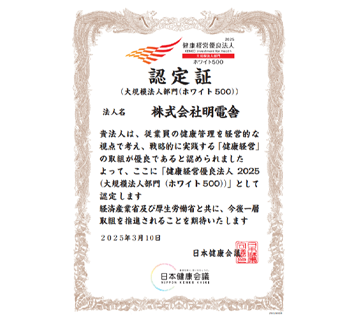
We entered the select Health and Productivity Management Outstanding Organization Recognition Program that is jointly recognized by the Ministry of Economy, Trade and Industry (METI) and Nippon Kenko Kaigi, and received 2025 Health and Productivity Management Outstanding Organization (White 500) Certification in the Large Enterprise Category. This marks the fifth consecutive year that we received Health and Productivity Management Outstanding Organization (White 500) Certification in the Large Enterprise Category.
White 500
White 500

(2) Smart Challenge Meiden Five

Smart Challenge Meiden Five

Meidensha has determined five health activities that we should engage in. Labelling them the Smart Challenge Meiden Five, we are continuing initiatives accordingly.

  • Challenge 1: Taking action for passive smoking and promoting the quitting smoking program

    We continuously offer a program for quitting smoking that can be taken online on an ongoing basis.
    Meetings were held with the staff in charge of quitting smoking promotion at each business site to share information on the status of non-smoking and the program, as well as information from the health insurance and the union, and to promote awareness and educational activities. After much consideration and many discussions about prohibiting smoking on all Company property, we decided to ban smoking during working hours at all sites, completely remove all indoor smoking rooms, and reduce the size of outdoor smoking stations.

  • Challenge 2: Measures to combat lifestyle diseases – under 39

    To date, we have provided pre-obese under-40s with individual health guidance programs. In addition to this, in order to reduce the number who may suffer from lifestyle diseases in the future, we held health seminars for all staff in their 30s to encourage them to take an interest in their own health and be cognizant of health as part of their daily lives. So that people in their 30s would take an interest in their own health while still young and change their behavior, the seminars incorporated the results of an advance survey and covered a broad range of information.
    We continued to offer individual health guidance, and provided such guidance to all employees 33 years of age.

  • Challenge 3: Measures to combat lifestyle diseases – over 40

    For people aged 40 and over, we conduct health guidance programs using ICT with the slogan “health guidance for the joy of achievement.” We have also introduced a new program aiming to help employees regulate their body clocks. We provided participants with exercise guidance and diet and lifestyle improvement programs according to their preferences.

  • Challenge 4: Measures to combat cancer

    To encourage women to undergo cancer screenings, we provide full subsidies for out-of-pocket expenses for gynecological cancer screenings (cervical cancer screenings and breast cancer screenings). We have enhanced our gynecological cancer screening system so that employees can be screened in the health examinations conducted by the Company. The Company, health insurers, and unions are actively promoting awareness activities, such as issuing reminders and information concerning early detection of cancer.
    In addition, we conducted an intensive educational campaign on colorectal cancer, for which the thorough examination uptake rate was low.

  • Challenge 5: Promoting mental maintenance

    We conduct interviews at workplaces with high health risks, encourage consultation with doctors for stressed individuals, etc., according to mental health plans.
    Additionally, to improve mental health literacy, we created and utilized training materials for self-care and manager-based care. We held discussions on mental safety in the workplace and created opportunities to improve communication.

  • Smart Challenge Meiden Five
    Indicator title Target
    (through FY2024)
    FY2020 FY2021 FY2022 FY2023 FY2024
    Taking action for passive smoking and promoting the quitting smoking program Rate of smoking 20% or less 21.8% 20.0% 20.7% 19.9% 21.4%
    Measures to combat lifestyle diseases – under 39 3Obesity rate of people in their 30s 30% or less 32.0% 30.7% 31.3% 30.8% 31.7%
    Measures to combat lifestyle diseases – over 40 Rate of people 40 and over who received specific health guidance 24% or less 26.7% 23.8% 23.4% 22.5% 22.8%
    Measures to combat cancer Regular checkups for cervical cancer and breast cancer 60% or above Cervical cancer
    19.0%
    Breast cancer
    32.0%
    Cervical cancer
    24.0%
    Breast cancer
    40.0%
    Cervical cancer
    27.0%
    Breast cancer
    47.0%
    Cervical cancer
    26.0%
    Breast cancer
    42.0%
    Cervical cancer
    29.9%
    Breast cancer
    49.4%
    Colorectal cancer thorough examination rate 100% 23.5% 42.9% 37.0% 57.9% 48.3%
    Promoting mental health maintenance Stress check rate 95% or above 96.6% 97.8% 97.5% 97.6% 97.8%

    scrollable

Health & Productivity Management Indicators (only Meidensha)

Item FY2022 FY2023 FY2024
Participants in the program for smokers to quit smoking 14 12 12
Participants in Meiden Smart Walking 1,019 1,179 1,207
Number of Health Web Kencom members 1,798 1,872 1,898
Rate of regular health examinations (%) 100 100 100
Rate of thorough examination, second examination, or treatment (%)*1 76 72 66
Rate of stress checks (%) 97.5 97.6 97.8
Rate of high stress (%) 13.8 15.0 13.7
Rate of consultations with highly-stressed workers (%)*2 7 8 4
Work engagement*3 2.43 2.40 2.42
Rate of smoking (%) 20.7 19.9 19.4
Regular health examination results (rate of conditions discovered (%)) Obesity (BMI of 25 or over) Male 33.7 35.9 33.7
Female 19.0 18.6 19.0
Total 31.3 33.0 31.3
Rate of blood pressure risks*4 1.2 0.6 0.6
Rate of blood pressure management (%)*5 58.4 47.4 49.9
Proportion of workers at risk of diabetes*6 0.4 0.3 0.3
Medical expenses per person (yen) 162,972 170,672 180,894
Insurance expenses per person (yen) 17,041 18,521 17,555
Ability to utilize health information (health literacy)*7 - 3.1 3.2
Absenteeism (proportion of workers taking mental health leave or other leave (%))*8 1.58 1.71 1.88
Mental and physical well-being (%)*9 71 70 68
above response rate(Percentage of total employees)(%) 61.1 79.3 82.1

scrollable

  1. *1Percentage of people who required thorough examinations or second examinations that actually received them
  2. *2Proportion of highly-stressed workers for whom a voluntary interview with a physician was conducted
  3. *3Indicator of a positive state of mind in relation to work. Work engagement is quantified by halving the sum of the values assigned to responses to two of the 80 items on the new job stress survey (“I feel energized at work” and “I feel proud of my work”) on a scale of 1 to 4 points, with 1 point for “Not at all” and 4 points for “Very much.”
    The response rate to the Work engagement survey is the same as the "Rate of stress checks" shown in the table above.
  4. *4Proportion of workers with systolic blood pressure of 180 mmHg or more or diastolic blood pressure of 110 mmHg or more
  5. *5Proportion of workers who manage their blood pressure as part of treatment for high blood pressure
  6. *6Proportion of workers with fasting blood sugar of 200 mg/dl or more
  7. *7Evaluations of “When I need to, I can determine plans and actions to improve my health based on information on illnesses and health”
  8. *8Proportion of employees who took sick leave or were absent for a month or more for mental health reasons. Totaled for all employees.
  9. *9Level of evaluated performance from “employee evaluations of their own work in the previous four weeks, with performance when not sick or injured acting as a baseline of 100%” in absolute presenteeism (single-item presenteeism question method)

Health Training Attendees (Whole Group)

Health Education Results (FY2024)
Training outline Number of times conducted Number of attendees
Online health seminar Session 1: Positive Mental Health to Increase Engagement: Taking Breaks Effectively
Session 2: A Talk from a Brewer “Healthy Drinking Habits”
Session 3: Stretching and Posture Analysis to Resolve Physical Ailments
3 1,467
(Including recorded online streaming)
New employees training Stress Management and Health Management 2 178

scrollable

Holding Health Seminars

We held joint health seminars with a health insurance association to increase the health literacy of our employees.

In the first half of FY2024, the seminar adopted the topic of “Positive Mental Health to Increase Engagement,” an important keyword in health and productivity management, while sessions in the second half of the year covered “Healthy Drinking Habits: Accurate Information on Alcohol” and “Stretching and Posture Analysis.”

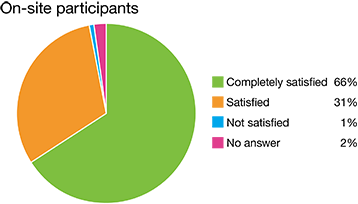
The seminar on stretching and posture analysis was originally intended for female employees, but was ultimately opened to all employees in the Meiden Group, including overseas employees. This session was also held as a hybrid “on-site” and “online” event broadcast simultaneously from Numazu Works, Ota Works, and Nagoya Works to develop a sense of unity. Following the seminar, digital signage displayed stretching videos to create an environment where people could continue the stretching exercise at their place when and where they preferred. In post-participation surveys, participants expressed sentiments like “My body feels loose and refreshed,” “I feel like I can do simple stretches every day now,” “They can be done while sitting, so I can do them at work,” “I reaffirmed how important stretching is,” and “Broadcasting from the three sites created a sense of unity.”

Results of post-seminar questionnaire
Results of post-seminar questionnaire
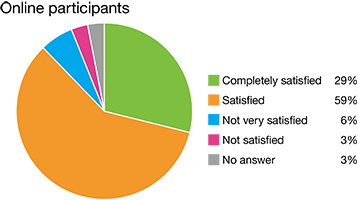
参Results of post-seminar questionnaire

Initiatives

Initiatives Aimed at Health and Productivity Management Going Forward

In FY2024, we were recognized as a 2024 Certified Health & Productivity Management Outstanding Organization (White 500), but we intend to further improve health and productivity while continuing to strive for ongoing certification in the future. We will advance initiatives to both support the well-being of employees and their families and achieve continued corporate growth, based on the Meiden Group Health & Productivity Management Policy Statement, the three pillars of health and productivity, and the Health & Productivity Management Strategy Map revised to align with Medium-term Management Plan 2027.

We place health and productivity management as the foundation of human capital management and will develop policies based on the central premise of increasing engagement. In particular, we will emphasize comprehensive approaches aimed at generating synergistic effects that mutually connect the three pillars of Healthy Bodies, Healthy Minds, and Healthy Workplaces.

For the Healthy Bodies aspect of the three pillars of health and productivity management, we will use past results from Smart Challenge Meiden Five as the foundation to establish issues based on changes in health matters and develop a new Smart Challenge 2027.

For Healthy Minds and Healthy Workplaces, we will continue to set implementation items and targets for those activities.

Healthy Bodies (Smart Challenge 2027) Action Items and Targets
Theme Summary of Action Items FY2027 Achievement Targets Defined Indicator
1) Improved health guidance Prevent serious lifestyle-related diseases and motivate those who neglect treatment 65% or more people at their ideal weight
50% participation in the Best Shape Program
People with a BMI between 18.5 and 25
The rate of participation in company health guidance activities that provide total support for healthy bodies
2) Establish exercise routines Measure physical fitness at sites and hold sports events 40% or more people with good exercise routines The percentage of people who meet 2 of the following 3 conditions with regard to their exercise habits:
Answer yes to the statement “For at least one year, I have been doing at least 30 minutes of light exercise two or more times per week”
Answer yes to the statement “My daily routine includes at least one hour of walking or similar physical activity”
Answer yes to the statement “I walk faster than most people my age and gender”
3) Eat balanced meals Improve understanding of the importance of meals and provide opportunities for healthy meals 50% or more people with balanced meals
50% of people with good eating habits
The percentage of people who most days eat 2 or more meals a day that combine a staple, main dish, and side dish
The percentage of people who meet 3 of the following 4 conditions with regard to their eating habits:
Answer normal or slower to the statement “I eat faster than other people”
Answer no to the statement “I eat dinner in the 2 hours before going to bed 3 or more times a week”
Answer mostly no to the statement “I eat snacks or drink sugary drinks between meals”
Answer no to the statement “I skip breakfast 3 or more times a week”
4) Get adequate sleep Conduct self-assessments of sleep time and quality and provide opportunities to improve them 80% or more people get good, rejuvenating sleep The percentage of people who say that they sleep enough to feel refreshed
5) Promote measures toward female health Hold events that promote checkups for female cancers
Understand issues and requests around women’s health
Hold seminars on women’s health issues
60% or more women get cancer screenings
70% or better health literacy (level of understanding about women’s health issues)
Percentage of women screened for breast and cervical cancer
Evaluations from surveys following each training session

scrollable

Healthy Minds and Healthy Workplaces Action Items and Targets
Theme Summary of Action Items FY2027 Achievement Targets Defined Indicator
Improve the ability to utilize health information (health literacy) Hold seminars for human capital and health and productivity management and conduct training via e-learning 70% or better health literacy (level of understanding training)  Evaluations from surveys following each training session
Prevent and cease the recurrence of mental health impediments Conduct mental health planning and implementation 73% or more people with healthy minds The absolute presenteeism (single-item presenteeism question method) of employee evaluations of their own work in the previous four weeks, with performance when not sick or injured acting as a baseline of 100%
Create healthy work environments where individuals can utilize their talents safely and with peace of mind Hold site hearings with experts on worksites with high health risks
Develop mental security KYT (Kiken Yochi Training, or hazard prediction training)
0% of worksites with high health risks The percentage of worksites with health risks of 130 or higher using the Stress Check Program

scrollable

For Employees Traveling Overseas

Developing Health and Productivity Management for the Entire Meiden Group, Including Overseas Production Sites

We ensure that overseas production sites educate their employees on the same health and productivity management policies as used in Japan, allow overseas workers to remotely join training on our polices to prevent infection when traveling and other health seminars, and conduct stress checks on international transferees.

• Our polices to prevent infection when traveling

We provide international transferees with pre-departure explanations from industrial physicians on overseas lifestyle, medical treatment, safety, etc., education concerning infectious diseases that are global health issues, including malaria, tuberculosis, and HIV/AIDS, recommendations on vaccinations for their destination countries, and other initiatives to maintain health.

• Remote participation in health seminars

15 employees at overseas sites remotely joined our Stretching and Posture Analysis health seminar, including the Chinese manufacturing site at MEIDEN ZHENGZHOU ELECTRIC CO., LTD.

Moving forward, we plan to deploy health and productivity management to the entire Meiden Group (including overseas production sites) and strengthen our capacity to respond to global health issues. We will enact regionally appropriate policies based on unified health and productivity management policies, while staying cognizant of the culture and legal system of each region.


Public Relations Section